
Planning Process

Designate an
Initiative Leader

Understand the Regulatory Landscape

Establish Your Baselines

Gather
Your Team

Set Your
Project Vision

Secure
Funding

Implement

Measure &
Verify
Designate an
Initiative Leader
Designate an Initiative Leader
Appointing your initiative leader — the person or persons who will orchestrate the process at the executive level — is the critical first step in the formation of the team (which will be discussed in detail in Step 4). The team will consist of key personnel drawn from across your institution, from leadership to operations, from finance to legal.
For now however it is important to take time to carefully consider who the leader of the team, and the entire decarbonization initiative writ large, will be.
This person may be a new hire, but will most likely be someone already working in a management or leadership capacity within the organization (a director of facilities, for example). This person may not carry the official title of “director”, but will serve in that capacity. The important part is to find the right person. A promising candidate who lacks some of the necessary skills might be trained in preparation for taking on the role.
The Role
The leader of your decarbonization initiative will be the individual responsible for developing and implementing your decarbonization and resilience strategy. They will function as the primary point of contact for all matters relating to the work. This person will report on the initiative to executive leadership, the hospital board of directors, senior management, regulators, shareholders and other external stakeholders on an as-needed or beneficial basis.
This leader must have deep subject matter and applied expertise in the field of hospital engineering & operations. Having knowledge and understanding of whole building carbon lifecycle as it relates to building construction and operations is also highly recommended. Your initiative leader will not be a project manager but rather a project executive. They will coordinate with one or more project managers to implement the strategy at a tactical level, ensuring that individual project tasks get accomplished on time and on-budget.
As an executive, the designated leader’s job is different. This person is charged with the project’s overall success. Their focus is more strategic than tactical, more about project vision than day-to-day tasks. The leader guides the team, not in the nuts-and-bolts of what needs to be done, but in the broad contours of what needs to be achieved.
What the Role Entails
The initiative leader is tasked with generating the ideas that help the team meet their overall goals. They are responsible for facilitating interdepartmental work, removing obstacles, solving problems, and resolving conflicts. For these reasons they must be creative, collaborative, and have outstanding interpersonal and communications skills.
Aside from these higher-level duties, initiative leaders have other important day-to-day responsibilities. Among them, ensuring that decarbonization and resiliency project teams are funded and staffed, that key roles are clearly defined and filled with qualified people, and that any new hires are trained. They must also be consistently monitoring progress, making sure the individual project teams are meeting goals, targets, deadlines, deliverables, and expectations.
Qualifications
The following is a list of suggested qualifications for the initiative leader role. It is not an exhaustive list, nor should every qualification listed be considered essential. The skills your organization needs to conduct its own decarbonization initiative will obviously vary. Also, in the filling of any role, it’s rare that a single individual possesses every needed skill. Consider training or dividing responsibilities among two or more individuals. Need to hire or recruit for the role? Below is sample job description help ensure that the right individual is selected.
Recommended Skill Sets
- Extensive leadership experience
- Outstanding organizational abilities
- Experience in business plan development
- Experience in finance
- Project management experience
- Problem-solving and decision-making skills
- A collaborative working style
- Strong verbal and written communication skills
- A working knowledge of all disciplines involved in the initiative
- Familiarity with data analysis and performance metrics
- The ability to critically review and interpret regulations related to sustainability (e.g. pending SEC Climate Rules)
- Knowledge of regulatory compliance reporting
- An understanding of the basics concepts of decarbonization
- An understanding of ESG at it relates to healthcare construction and operation
- A clear understanding of the carbon lifecycle
- The ability to review and interpret voluntary standards, guidance, and reporting frameworks (e.g. GHG Protocol, ISO 14064 series, PAS 2060 carbon neutrality, Science-based targets initiative (SBTi) guidance)
- CEM (Certified Energy Manager) certification
- LEED AP or other Green Building Program Certifications
Every hospital may not have all of the recommended skills or certifications listed above in one leader at the very start. However, not having the complete list should not preclude a hospital form starting. The list above is recommended, but not mandatory. Hospitals are still encouraged to move forward with establishing a leader and empowering that leader to build out their decarbonization and resiliency plans. External training programs exist today, and the missing skill sets can be added on the go.
Understand the Regulatory Landscape
Understand the Regulatory Landscape
Hospital decarbonization efforts are being driven in large part by new legislation being enacted to contain the climate crisis. The specific rules and regulations contained in these laws will not be covered in this section, however, it is important as your planning process gets underway to understand the broad strokes of state, local and federal climate policies and the implications of those policies for your decarbonization and resilience efforts.
Federal
Federal legislation specific to climate change is expected in the coming years. The Biden administration’s goals to address the climate crisis include reducing U.S. greenhouse gas emissions 50-52% below 2005 levels in 2030; reaching 100% carbon pollution-free electricity by 2035, and; achieving a net-zero emissions economy by 20501.
While prospective Federal legislation will not necessarily impact your current project planning efforts, there are important Life Safety and Environment of Care codes that will need to be considered.
State
On July 18, 2019, New York State’s Climate Leadership and Community Protection Act (Climate Act) was signed into law. The Climate Act is among the most ambitious state climate laws in the nation, requiring New York to reduce economy-wide greenhouse gas emissions by 40 percent by 2030 and no less than 85 percent by 2050 from 1990 levels2.
As New York’s highest emitting sector, buildings are responsible for roughly one third of all greenhouse gas emissions statewide3. As recommended by the Climate Action Council in the State’s Scoping Plan, by 2050, 85% of homes and commercial building space statewide should be electrified with energy-efficient heat pumps and thermal energy networks4 — ensuring they are energy-efficient, comfortable, affordable, and resilient. In addition, the Climate Act mandates that no less than 35% (with a goal of at least 40%) of our climate action benefits will go toward New York’s disadvantaged communities5. By working closely with communities and equity experts, New York State’s climate work will help address the ongoing challenges and barriers these communities — and their hospitals — are facing.
Hydrofluorocarbons
On October 15, 2016, 197 countries committed to dramatically reducing the production and consumption of hydrofluorocarbons (HFCs) under the Montreal Protocol in Kigali, Rwanda. The protocol commits participating countries to an ambitious phase-down schedule, reducing HFCs by more than 80% over the next 30 years6.
In this spirit, the New York State Department of Environmental Conservation adopted 6NYCRR Part 494, Hydrofluorocarbon Standards and Reporting, which prohibits certain HFC substances in certain end-uses7. The prohibitions went into effect statewide starting in 2021 and include the sale, installation, and commercial use of certain refrigerants in new or retrofitted food refrigeration equipment, large air conditioning equipment (or chillers), and vending machines as well as prohibitions on substances used in foams and as aerosol propellants in new consumer products. The proposal also includes administrative and record-keeping requirements for manufacturers of the affected products.
Local
Regulation of greenhouse gas (GHG) emissions at the local/city level is relatively new but gaining momentum. At the leading edge of this movement is New York City, which in 2019 passed Local Law 97, a major new piece of legislation designed to make New York City carbon neutral by 2050. This law will no doubt become a model for other municipalities around the State of New York looking to reduce their emissions and make a positive climate impact.
Local Law 97 is part of the Climate Mobilization Act, passed by the City Council in April 2019 as part of Mayor de Blasio’s New York City Green New Deal. Under the law, most buildings over 25,000 square feet will be required to meet new energy efficiency and greenhouse gas emissions limits by 2024, with stricter limits coming into effect in 2030. The goal is to reduce the emissions produced by the city’s largest buildings 40 percent by 2030 and 80 percent by 2050. The law also established the Local Law 97 Advisory Board and Climate Working Groups to advise the city on how best to meet these aggressive sustainability goals8.
Other relevant local laws include LL11 (facade), LL88 (lighting and sub metering), LL84, LL87 and others that your organization should be familiar with as you kick off your decarbonization planning process.
You can find more details on emissions limits, plus more information regarding buildings that may be exempt from Local Law 97 at the Department of Buildings (DOB) Greenhouse Gas Emission Reporting website. Note that Local Law 97 was amended in 2019 by Local Law 147, and other amendments have followed. Those amendments can be viewed in §28-320 and §28-321 of the Administrative Code.
1The White House Official Website, https://www.whitehouse.gov/climate/
2State of New York Official Website, https://climate.ny.gov
3New York State Office of General Services, https://ogs.ny.gov/sustainable-buildings-and-infrastructure
4 1State of New York Official Website, https://climate.ny.gov
5Ibid.
6U.S. Department of State Official Website, https://www.state.gov
7New York State Department of Environmental Conservation, https://www.dec.ny.gov
8NYC Mayor’s Office of Climate and Sustainability, https://www.nyc.gov
Establish Your Baselines
Establish Your Baselines
Vital to the process of decarbonizing is establishing reliable baselines. This simply means measuring the state of your hospital’s facilities to see how they perform on various key performance indicators (KPIs) like energy usage and emissions.
The usefulness of baselining goes well beyond establishing your hospital’s current performance. A proper baseline will serve as a critical point of reference for all your upgrade and improvement projects. Your baseline will not only allow to accurately gauge the success of your efforts when you get to the Measure & Verify step (Step 8), it will allow you to judge how your facility is operating relative to other hospitals in New York State and around the nation.
An easy way to get started in the baselining process is to complete the Baselining Survey here.
An Introduction to Baselining
In every facility, an array of building systems (HVAC, energy, lighting, utilities, telecom) work together to form a comprehensive operational infrastructure. By breaking these systems down into their associated components, monitoring system activity and then measuring the activity of each component individually, you can gain an understanding of both the component and overall system performance and impact.
For example, an HVAC system accounts for between 40% and 60% of a facility’s total energy consumption1. By separating out all the components in your HVAC system, monitoring them individually, and measuring that performance, you’ll gain an understanding of exactly how and where that 40-60% is being used, so you can devise targeted and specific strategies for increasing efficiency and resilience.
The baselining process will help you to develop a list of potential improvement projects, prioritize them, even fund them.
As time goes on, your baseline will become an increasingly valuable tool, particularly when it comes time to start measuring your performance gains. It will help you identify critical performance gaps, even troubleshoot (for example, if a particular project was expected to reduce energy consumption by 10% but ended up increasing it by 5%, the baseline will provide important clues as to where and the problem is occurring, and put you on a path to resolving the performance gap).
The Baselining Survey
An easy way to get started in the baselining process is to complete the Baselining Survey here.
Basic Baselining: Consumption Tracking
Baselining and measurement can be a complex process. As a general rule, the more rigorous your baselining and (eventually) measurement program is, the better positioned your facility will be to report on the results that have been achieved, and capitalize on the improvements that have been made.
Still not every hospital has the resources is takes for such in-depth data tracking. In such instances some basic measurement is far preferable to no measurement at all.
An excellent place to begin to simply track your facility’s energy consumption on a monthly and annual basis. When it comes time to measure your results, a detailed log of your hospital’s utility bills will provide you with at least one reliable indicator of whether your efficiency efforts are paying off.
Baselining Tools and Resources
The Energy to Care Dashboard Tool
A popular tool for hospitals, ASHE’s Energy to Care Dashboard Tool is an easy-to-use benchmarking and monitoring tool that provides an at-a-glance view of your facility’s energy use. Designed to deliver comprehensive monitoring with a time investments of roughly 15 minutes a day, The Energy to Care Dashboard Tool combines a clean and simple interface with powerful features including ENERGY STAR® data options, energy and cost data widgets, and utility bill fault detection.
ECO-Ill Energy Conservation in Hospitals
These guidelines, which resulted from a joint initiative by the US Government and the Government of India, provide benchmarking tools for energy systems as well as tools to help builders estimate the efficiency gains from more efficient building designs.
GHG Inventory Development Process and Guidance
The EPA provides a thorough and highly useful protocol for inventorying greenhouse gas emissions through the Center for Corporate Client Leadership. The tool is based on a four-step process that covers standards and methods, data collection, mitigation plan development, and reporting.
All HVAC systems in current use fall into one of four categories. Those categories are Air-to-Air, Air-to-Water, Water-to-Water, and Water-to-Air. Each has its own unique architecture and set of system components.
The Practice Greenhealth Network Benchmark Tool
This tool is available to users of the Practice Greenhealth Network and those of Healthcare Without Harm. It allows users to enter information about their electricity use, thermal energy use, and emissions. The calculator then converts the information into impact estimates on community health and wellness.
The estimates cover factors ranging from illness and early mortality to missed workdays and other effects. The calculator will estimate using regionally appropriate factors if the user enters their geographic information.
Gather
Your Team
Gather Your Team
Your project team will be your single most important asset in developing and implementing a successful decarbonization and resilience strategy. The team will not only help you devise your improvement plan, but they’ll also help you sell it across your institution, get it approved and funded, and ultimately execute it. For this reason, you’ll want to start assembling your team sooner rather than later. Regular progress check-ins with your executive sponsor and corporate leadership during the team formation process (and after) are essential.
Note that depending on the size and structure of your organization, your decarbonization project team may not be a newly created team, but one that already exists (i.e. your management team) and is simply repurposed to take on responsibility for the decarbonization initiative. Alternately, you may need to bring added resources in to fill qualifications the organization lacks. New hires are an option, but consider also outside consultants or other kinds of partners.
The Roles You’ll Need to Fill
Because it’s important to have as many qualified eyes on the process as possible — as early as possible — you’ll want to begin filling roles as soon as some of your early strategy goals become apparent. It can’t be emphasized enough that without the right team in place, long-term success is impossible. So consider carefully and choose well.
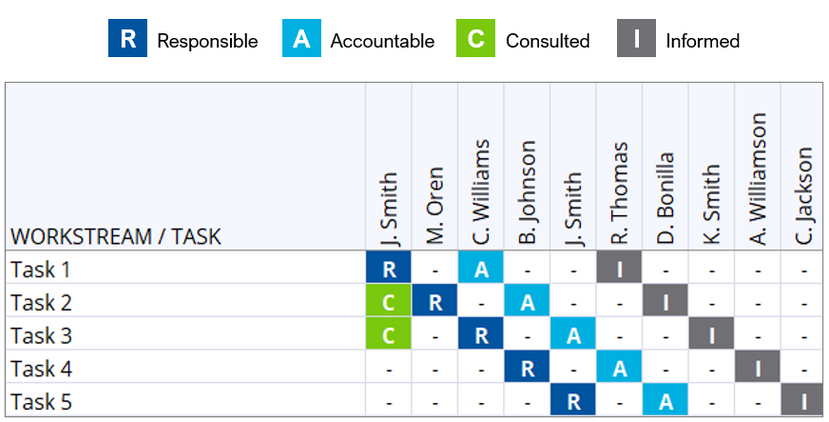
The following is a list of recommended roles, but it is not exhaustive. Add whomever you need to help ensure success. We encourage you to populate the below RACI matrix tool to help clarify roles, responsibilities, and relationships and ensure clear communication as well as smooth and streamlined workflows. The tool has been designed to help ensure that the right individuals/teams are connected to and consulted during the appropriate times throughout the strategy implementation process.
Boards/Foundations/Executive Suite – Accountable
Clinical Staff / Infection control – Consulted
Engineering & Design & Construction – Responsible
Facilities & Operations – Responsible
Procurement Purchasing – Consulted
Finance / Tax – Consulted
Legal / Contracts – Consulted
Sustainability / ESG – Consulted/Informed
Human Resources – Consulted
Marketing & Communications – Informed
IT/Security Infrastructure – Consulted
Remember That Decarb is About More Than Your Facility
The most effective hospital decarbonization teams include an array of stakeholders drawn from clinical operations as well as facility operations. Aside from the resilience measures and capital outlays that facility modernizations require, some of the most difficult aspects of decarbonization are the long-term modifications that need to be made to practices. Any roadmap to decarbonization must balance carbon reduction and resilience with patient safety and the clinical innovations that will lengthen the lives of patients. Without a complement of clinic staff on your team, such a balance will be difficult to achieve.
Selecting Team Members
When it comes to selecting your team, remember that there’s more to a great team member than their specific subject matter expertise. Effective team members combine knowledge with experience plus an array of other important skills. When choosing a team member, look for:
Willingness to commit to the project, participate in it actively, and see it through to its conclusion.
Organizational skills, including the ability to set goals, break down goals into tasks, prioritize those tasks, manage time, adhere to deadlines, and delegate if needed.
Communication skills including the ability to write, speak, and listen well, and address the concerns of others.
Interpersonal skills, such as the ability to collaborate, give and take direction, receive constructive criticism, and resolve conflicts.
Energy & resourcefulness. An ideal team member is highly motivated, self-starting, and possesses resources including the connections, resources, and influence it often takes to get difficult tasks accomplished.
The NYSERDA On-Site Energy Manager Program
Because it’s challenging enough designing a decarbonization strategy, to say nothing of staffing one, NYSERDA has created the On-Site Energy Manager (OsEM) program, which provides full or part-time on-site energy managers to help organize and implement your decarbonization projects.
OsEMs are responsible for helping your institution achieve leaner operations by creating efficient processes that decrease energy waste and its associated costs. The program provides a 75 percent cost-share for buildings to hire an OsEM.
An OsEM can be hired for operations and maintenance improvements, energy efficiency upgrades, water saving improvements, and more. The energy manager can be either a new permanent hire or a contractor. To learn more about the OSEM program, go to the NYSERDA website.
Set Your
Project Vision
Set Your Project Vision
Your vision is the set of motivating ideas and concepts behind your strategy. It establishes the aspirational values and goals that your your team is working towards. While every decarbonization strategy might be prompted by decarbonization regulations, decarbonization may not be the primary motivator for your team or your institution. Your team’s motivating vision might be rooted in world-class patient care, the creation of a future-ready hospital, cost savings, or some combination of several value drivers. Whatever your vision is, that vision will be your inspiration and your guide for as long as the project lasts.
A good vision statement should take some time to write, and the exercise in developing it should be a collaborative effort for the entire team. Note that a good vision is not specific. It is not about the “how” of getting your project done, but the “why”. It should speak to the impact you want to produce, and the ways in which your institution, your patients, your community, and the world around you will be better for your efforts. In other words, a good vision statement should inspire all who interact with it in ways that are intuitively relatable to every audience.
Here are a few Best Practices to keep in mind as you start writing your vision statement:
Be Bold.
Think of your vision statement as your declaration: what you intend to do and why it matters. Be clear, unambiguous and high-minded, though of course not so high minded that your goals and objectives aren’t actually feasible.
Keep it simple.
The best vision statements use language everyone can understand, not industry buzzwords or jargon. More than that, they’re short and clear. Shoot for two-to-three sentences.
Collaborate.
Not everyone on the team has to participate in writing the vision statement, but everyone needs the chance to contribute ideas. It’s the best way to ensure buy-in from the whole team. Gather broad input during the writing process, and as drafts are created, circulate them for feedback.
Basic Steps
Here are a few basic steps to guide you through the process:
Remember who you’re speaking for. Your vision statement will speak for the team, but it will also speak for the organization a whole and for the people and communities that your organization represents. When setting out to write your statement, make sure you have the participation of team members from multiple levels and areas of the organization.
Remember your audience. Every good piece of writing is written to be read by a specific audience. Make a list of the stakeholders who will be on the receiving side of this communication (from board members to employees and patients/customers). It will help you to choose words and set tone.
Gather material. Start by answering the big questions: what are we doing? Why does it matter? In what way does our project reflect our organization’s values? Answering these basic questions will give you a good amount of material to work with.
Define what success will look like. When your decarbonization projects have been completed, what will your facility look like? What benefits will be realized by the community? What kind of savings will be realized, or improvements made to quality of care? Be as specific as you can be with what you plan to achieve.
List and prioritize your ideas. There’s no need to start writing sentences right away. Try listing the main ideas you’d like to communicate, order them according to the ones that are most important, and eliminate any repetitive ideas. Some find a word cloud generator to be a useful tool for this step.
Write. Now that you’ve got plenty of material, it’s time to start crafting sentences. Try to keep the sentences short without stacking too many idea ideas one on top of the other. Remember: you don’t have to be exhaustive. Don’t worry about length for now, you can edit later.
Take a break, then edit. If you’re like most vision statement writers, you’ll have at least a paragraph of text by the end of step six. Now’s a good time to take a breather, maybe let the statement sit for a day or two, then come back and edit. When editing check again for jargon and redundancies. Does it flow? Does it make sense? Is it clear? Pass the statement around for input. Repeat this step as many times as it takes to get to your final, concise statement.
Best Practices
Here are a few best practices to keep in mind as you start writing your vision statement:
Be Bold. Think of your vision statement as your declaration: what you intend to do and why it matters. Be clear, unambiguous and high-minded, though of course not so high minded that your goals and objectives aren’t actually feasible.
Keep it simple. The best vision statements use language everyone can understand, not industry buzzwords or jargon. More than that, they’re short and clear. Shoot for two-to-three sentences.
Collaborate. Not everyone on the team has to participate in writing the vision statement, but everyone needs the chance to contribute ideas. It’s the best way to ensure buy-in from the whole team. Gather broad input during the writing process, and as drafts are created, circulate them for feedback.
Creating Your Strategic Plan
The baselining work you have done in Step 3 should have provided you with a list of some of the most important elements of your high-level plan. You most likely had a few potential projects of your own in mind before the baselining step even began. Now, with these lists in hand, you’re ready to start drawing up a detailed strategy that includes a detailed list of starting projects as well as a list of potential funding sources, external and internal.
The Decision-Making Matrix linked below will give you a solid start on that process. This multi-page spreadsheet tool will allow you to enter your list of potential projects, weight their importance, score them according to various criteria, assess their financial impact, and even create preliminary budgets for them. In short, it contains everything you need to create a realistic and actionable strategic plan. NOTE: a brief video has been provided below to help you familiarize yourself with the tool.
Secure
Funding
Secure Funding
Next to resilience, the number one concern for any hospital decarbonization initiative will be securing the funds needed to launch the project.
The good news is there is an abundance of financial, technical, and staffing incentives and resources created specifically to encourage decarbonization, clean energy, and resilience projects in the hospital and healthcare sector.
For financially distressed hospitals — i.e. hospitals that fall under the category of Safety Net Hospitals — there are added special incentives.
Enhancing the Financial Value Proposition
No institution ever has the funding and resources it needs to do all the things that it wants to do. More challenging still is that fact that decarbonization/clean energy projects often compete for financial resources with other types of projects which are often life safety- or patient care service-focused.
More traditional types of projects often have the advantage of being revenue generating, which can make them more attractive for funding relative to a decarbonization project. That said, while decarbonization projects may not be revenue producing, they certainly can reduce operating costs and make a positive impact on the bottom line.
Because decarbonization projects are considered investments by the organization, it can be useful to highlight the payback period (which can be less than a year in many cases). Ultimately it will be the cost and the perceived value of the cost that will decide whether the project gets funded.
For that reason, improvements to the financial value proposition can be invaluable in terms of making a decarbonization project more attractive. Such improvements can come in the form of Federal, state, local, and utility incentives that can be leveraged to improve project financing and offset the costs associated with planning and implementation.
Available Resources
Below is a list of Federal, state, and local programs that should help get you started. Be aware that this list is by no means exhaustive.
Federal Programs & Incentives
The Federal government offers a range of programs, incentives and tax credits to businesses (as well as state & local governments) seeking to initiate decarbonization and clean energy initiatives. These are listed below according to the relevant agency.
US Department of Energy
Better Buildings Financing Navigator
The Better Buildings Financing Navigator is a useful introduction to energy finance issues facing the healthcare sector. The Navigator contains market data, case studies and other resources designed to help healthcare managers take advantage of newer and/or more innovative financing strategies.
Loan Programs Office Clean Energy Financing Program
For prospective borrowers looking for flexible, customized debt financing solutions, this program document contains a useful overview of the Title 17 program.
The Inflation Reduction Act of 2022
The IRA’s Energy Infrastructure Reinvestment (EIR) program offers loans to organizations that replace or retool energy equipment that is no longer functioning, or that are emitting pollutants or greenhouse gases.
US Department of Health & Human Services
Compendium of Federal Resources for Health Sector Emissions Reduction and Resilience
A Compendium of Federal Resources features funding opportunities, tools, and supports from the federal government designed to assist the health sector in the work of climate resilience and greenhouse gas emission reduction.
US Environmental Protection Agency
Clean Energy Finance Tools and Resources
EPA created this list of tools and resources to help state and local governments gain a better understanding of the range of financing options for clean energy investments.
This tool was created to help organizations find rebates and special offers on ENERGY STAR-certified products.
Internal Revenue Service
The IRS offers a variety of tax credits and deductions that may be applicable to your decarbonization efforts. These include:
Tax Credit Section 48 Investment
Tax Credit Section 45 Production
Tax Credit 30C Alternative Fuel Vehicle Refueling Property Credit
48E Clean Energy Investment Tax Credit
179D Energy Efficient Commercial Buildings Deduction
State Programs & Incentives
Hospitals face a unique set of challenges when it comes to energy management programs and the adoption of clean energy technologies. NYSERDA provides a variety of funding and incentives to help hospitals overcome these obstacles, as well as the cost barriers to energy-saving investments.
NYSERDA’s Flexible Technical Assistance (FlexTech) Program
The Flexible Technical Assistance Program was created to support organizations interested in implementing clean energy or energy efficient technologies. The program covers between 50% and 75% of the cost of any project that helps identify opportunities for energy cost reductions. A fact sheet is available here.
NYSERDA’s On-site Energy Manager Program
Dedicated on-site managers are tasked with creating and implementing processes that decrease energy cost and energy waste. An energy manager can help organizations reduce maintenance costs, create safe and comfortable spaces, and lower their overall operating costs.
NYSERDA’s Strategic Energy Management Program
Strategic Energy Management is a practice intended to bring energy efficiency practices into line with business practices with the goal of achieving long-term benefits. NYSERDA offers two different options for energy management training, both of which are fully funded. Guided by a NYSERDA coach, program participants will learn how to develop their own SEM plan for achieving environmental goals while at the same time increasing profitability and enhancing resiliency.
NYSERDA’s Workforce Development Programs
NYSERDA offers programs to promote the advancement of clean energy in New York State. The Building Operations and Maintenance Training Program aims to reduce energy use and associated carbon emissions while saving building operators and owners money by developing and strengthening the skills of operations and maintenance (O&M) staff and managers across the state. The program is designed to equip building O&M workers with the skills to operate increasingly energy efficient, grid- flexible, and electrified building systems that reduce buildings’ contribution to climate change.
NYSERDA’s Carbon Neutral Community Economic Development Program
NYSERDA’s Carbon Neutral Community Economic Development program supports projects in two categories:
Category A: Carbon Neutral Facilities. This category supports supports carbon neutral or net zero energy facilities through efficiency measures, renewable energy integration, and electric vehicle infrastructure for both existing and new buildings.
Category B: Carbon Neutral Communities. This category aims to achieve carbon neutrality at the community level, including large-scale developments like campuses or real estate portfolios, by promoting community-based planning and large-scale project implementation.
NYSERDA’s Commercial & Industrial (C&I) Carbon Challenge
NYSERDA’s C&I Carbon Challenge aids large non-residential energy users in accessing resources for deep decarbonization efforts. Through a competitive proposal process, it supports the implementation of top energy-saving and carbon-reduction projects. Winners receive dedicated support from NYSERDA, simplifying the process compared to dealing with multiple initiatives.
NYSERDA’s Electric Vehicle Charge Station Programs
Providing charging for employees and visitors is a great way to attract and retain employees and reduce one of the largest sources of a hospital’s GHG emissions. The State of New York offers incentives in the form of tax credits (both state and federal), utility programs, and NYSERDA programs to reduce the cost of charging station installations.
For employees, EV charging is a great perk (some employers provide charging at low or no cost) and access to workplace charging has been shown to dramatically increase the likelihood of an employee buying an EV.
NYSERDA offers a wide range of best practice guides and case studies for people interested in installing commercial and workplace charging stations that include siting design, employee charging policies, and strategies for reducing the cost of installations.
Additionally, hospitals can work with local transit operators or other mobility providers to ensure that there is adequate bus or other transit access and that employees and visitors can get to the facility on bike or by walking.
If there are bikeshare services in the community, the hospital could be a great location for a bike hub. Make sure there is ample bike parking to encourage employees to bike – this can save money for all (including the hospitals, by avoiding having to add more parking) and improve health outcomes.
The Drive Clean Rebate offers point-of-sale rebates toward either the lease or purchase electric cars. It is open to all New York State residents.
NYSERDA’s New York Truck Voucher Program
For truck fleet owners interested in advancing their energy transition goals by replacing their old diesel-powered vehicles with cleaner vehicle technologies, the New York Truck Voucher Incentive Program is an outstanding resource. It provides vouchers (or discounts) that can be applied toward the purchase of propane, compressed natural gas (CNG), all-electric (BEV), plug-in hybrid electric (PHEV), conventional hybrid electric (HEV), or hydrogen fuel cell electric (FCEV) vehicles, either medium- or heavy-duty (weight classes 3-8).
NY Green Bank, a Division of NYSERDA
NY Green Bank works to address and alleviate financing gaps where capital may not be readily available from conventional lenders due to various barriers (i.e., limited familiarity with particular asset classes, perceived uncertainty of revenue streams from projects such as those involved with building decarbonization efforts, and minimal standardization across project types – resulting in transactions with limited precedent).
NY Green Bank investments span a wide range of climate change-mitigating technologies, from building efficiency to energy storage to clean transportation. NY Green Bank can work with hospitals as well as with their tenants, contractors and service providers to support projects such as fleet electrification, electric infrastructure upgrades, on-site power generation, demand management and building efficiency.
NY Green Bank can take various roles in the capital stack and project lifecycle (i.e., project finance lending, on-lease tenant financing, receivables financing) and be a flexible and dynamic lending partner, bringing the ability to bridge incentives (including NYSERDA and utility incentives), potential uses of proceeds that are not limited to energy or sustainability related measures, the ability to underwrite to higher expected energy savings than some traditional lenders, and the ability to support pay-as-you-save and/or energy-as-a-service structures.
To access the New York Green Bank’s website, please use the following link.
To contact the New York Green Bank, please use the following link.
Local Programs & Incentives
Local governments interested in making clean energy transitions will find this tool — which is designed to help them prioritize and leverage available federal funds — extremely useful.
Database of State Incentives for Renewables & Efficiency (DSIRE)
An exhaustive list of the various incentives, programs, rebates, and tax exemptions available across the State of New York and in specific localities.
Utility Programs & Incentives
ConEdison offers a variety of incentives for businesses launching efficiency and decarbonization programs. They’re grouped into two main programs, the Savings for Commercial and Industrial Customers program which offers cash incentives for installing energy efficient electric and gas equipment, and the Clean Heating and Cooling Technology for Commercial and Industrial Buildings program, that helps organizations comply with local laws by modernizing their building and hot water heating systems with new heat pumps.
National Grid is an energy company operating in the UK and US that delivers electricity and gas with an eye toward a clean energy future. National Grid offers a broad range of incentive and rebate programs — include customizable incentive programs — for business looking to upgrade or replace outdated and/or inefficient systems including gas, electric, lighting, HVAC, water, motor systems and more.
PSEG Long Island’s Business and Commercial Rebate program is designed to help businesses with the up-front costs of equipment replacements and upgrades to their VRF, chiller, building control, and lighting systems.
RG&E’s Commercial and Industrial Rebate Program provides rebates to non-residential electric and natural gas customers for energy efficiency upgrades to facilities and equipment.
Implement
Implement
Implementing your decarbonization program will be a multi-year, and potentially a multi-decade process. It will likely be made up of a series of discrete projects, each of which will vary in size, scope, cost, and impact, and each of which will need to be individually planned, scheduled, financed, budgeted, executed, and measured.
That’s a lot of work. But when projects are executed well, with the right combination of executive leaders, project managers, technical experts, contractors and stakeholders, all leveraged collaboratively and in the right way, results can materialize quickly.
This next section will cover this process, known as implementation, at a high level. For some users of this guide, project implementation will not be a new concept. Others will no doubt find this brief overview of key concepts informative and useful.
Project Planning and Design
The Project Planning and Design phase will be similar to the process you have already gone through for the development of your broader decarbonization strategy but at the project level.
You’ll lay out your project’s scope and goals, measure your facility’s current energy consumption and carbon emissions, and inventory your available resources.
You will also take the critical step of selecting a qualified project team, the members of which will help you design your project, draft necessary documentation, prepare budget and timelines and manage the project through to successful completion.
For the crucial concept and design phase, some project directors find it helpful to use a workshopping or charette-based approach, whereby selected experts in engineering, environmental science, and policy come together in a collaborative setting to help shape the project at a high level.
Whatever method you choose, once the project has been defined, the next step will be for the project team to decide on the particular engineering, design and construction approaches that will be implemented, the technologies that will be deployed; what kind of renewable energy systems or energy-efficient infrastructure will be utilized, and what types of building modifications will be required to accommodate them. This step will help establish the overall project roadmap, and help define the project’s various stages.
Note that for very large projects it’s important to consider whether your plan will be implemented all at once as part of a single large project, executed in a piecemeal fashion, on a building-by-building basis, etc. It is also worth considering whether a single consultant firm has the resources to manage the full scope of your project, or whether several firms working in close coordination might better handle the project in its entirety.
Scheduling
Developing a well-conceived, realistic schedule will be essential for maintaining project momentum. It will also be critical to making your cashflow projections. Creating an overall project timeline should be the first step. Note that this timeline should take into account various factors like regulatory approvals, business model constraints, funding availability, supply chain constraints, operational and care impacts, and financing limitations.
Once the timeline is complete, establish key milestones and phase gates that will help to ensure that the project remains on track and delays are minimized. Note that every good schedule incorporates contingency plans, as all plans encounter unexpected delays and difficulties. An effective schedule is flexible, yet project aligned with the broader timelines and overall project goals.
Note also that depending on the size of the project, more than one schedule might be useful: one long-term strategy-level schedule and one tactical (or more) project-level schedule might be considered.
Budgeting and Capital Allocation
Because capital is the fuel that keeps every improvement project moving, proper budgeting will be crucial to your project’s viability. Begin with a comprehensive cost estimation. Make sure to include line items for things like equipment procurement, labor, permitting, and potential contingency/risk management.
Next, allocate the budget to the various aspects and phases of your project, making sure it is aligned with the project timeline to help ensure that the necessary resources are available as they are needed. Where possible, set aside contingency funds to address unforeseen circumstances. The most successful project managers maintain a certain amount of “financial resilience and flexibility” over the course of the project’s lifecycle.
d be the first step. Note that this timeline should take into account various factors like regulatory approvals, business model constraints, funding availability, supply chain constraints, operational and care impacts, and financing limitations.
Once the timeline is complete, establish key milestones and phase gates that will help to ensure that the project remains on track and delays are minimized. Note that every good schedule incorporates contingency plans, as all plans encounter unexpected delays and difficulties. An effective schedule is flexible, yet project aligned with the broader timelines and overall project goals.
Note also that depending on the size of the project, more than one schedule might be useful: one long-term strategy-level schedule and one tactical (or more) project-level schedule might be considered.
Funding Applications and Financing
Depending on the project focus, scale, impact/outcome, and anticipated economic payback, funding resources can come from any number of sources, including government grants/incentives (e.g. Federal IRA program), private investors/financing, internal reserves, and public-private partnerships.
Consider hiring an experienced consultant or firm to help you prepare funding applications. When writing a grant or incentive funding application, remember to include as many detailed project plans, design specifications, and expected environmental benefits as possible, as they will add weight and credibility to your application.
Construction Delivery Selection and Bidding
Entire books have been written on various project delivery methods, so there is little need trying to summarize them here. However, a brief discussion of their applicability to decarbonization and resilience projects may be helpful.
Depending on the size of your project, conventional design-bid-build, design-build, and construction manager at risk (CM-at-risk) might all be feasible approaches. That said, design-build may be the best approach for discrete projects, whereas design-bid-build might make more sense for larger projects where more external financing is needed.
Conventional design-bid-build may be best for projects that impact infrastructure systems campus-wide, as they typically require detailed design of complex systems. CM-at-risk may be preferable for logistically complex projects undertaken inside occupied buildings, as these projects usually have significant enabling and phasing requirements. All that said, it’s quite possible you’ll end up utilizing all three delivery methods over the course of implementing your decarbonization strategy.
Regardless of the delivery method you choose however, contractors and subcontractors should be selected through a competitive bidding process in line with your Institution’s purchasing policies. The selection process should consider the vendors’ technical capabilities, past experience, and proposed costs and a variety of other factors.
Construction
The construction phase will be the realization all your hard work. As with every healthcare construction project, be sure to pay special attention to infection control and life safety considerations. Closely monitor the construction process, ensuring that it adheres not only to the approved designs, but to all planning/zoning/permitting requirements, jurisdictional regulations, and your own institution’s high-quality standards.
Regular site visits, progress reviews, communication with contractors, and 3rd party QA/QC not only help to ensure a smooth-running project, they’ll help you to promptly address any emerging issues. Following established health, safety, and environmental regulations to the letter will help ensure that your contractors, workforce, patients, clinical care staff, and the surrounding community are kept safe.
Commissioning/Retro-Commissioning and Quality Control
As construction nears completion the project enters the commissioning phase. This will involve rigorous testing of all equipment, systems, and processes to ensure they operate as intended. Quality control measures will be implemented to identify (and/or rectify) any discrepancies or performance gaps.
Make sure your project team collaborates closely with your commissioning agent (CxA) to fine-tune your systems for optimal performance. Once commissioning is completed, the finished project will be officially handed over to your institution’s operations and maintenance team, ensuring its sustainability and positive environmental impact for many years into the future.
Measure &
Verify
Measure & Verify
Measurement and Verification (M&V) is another step that will benefit from a thorough initial baselining. It’s the point at which you will refer back to your initial KPI data to see how well the finished project is tracking with early projections.
Given the likely complexity of some of some of your decarbonization and resilience efforts up to now, it won’t be surprising that the Measurement and Verification process can be quite complex.
That said, some of the very basic measurement techniques referenced in the Baselining section can also be quite useful. The simple utility bill analysis mentioned in that section is a quick and easy way to assess how well your projections are matching up to your actual monthly/annual savings.
For in-depth M&V programs, which are highly recommended, there are several excellent resources available for free online.
Freely Available Measurement Guides
Provided by US Department of Energy
M&V Guidelines: Measurement and Verification for Performance-Based Contracts Version 4.0
This document contains procedures and guidelines to help organizations quantify the savings that result from the installation of energy efficient equipment, water conservation efforts, operations and maintenance improvements, renewable energy initiatives, and cogeneration projects conducted under performance-based contracts.
Provided by U.S. Environmental Protection Agency
Guidebook for Energy Efficiency Evaluation, Measurement, and Verification
Developed by the EPA’s State and Local Energy and Environment Program, this guide helps homeowners, businesses, and other organizations confirm that their energy efficiency programs are resulting in the expected levels of energy savings, and ensure their quantification and verification approaches are well-documented, rigorous, and consistently applied.
Provided by New York State Department of Public Service Office of Clean Energy
Evaluation, Measurement & Verification Guidance
This document was created to provide guidance to utilities, the New York State Energy Research and Development Authority (NYSERDA), and other evaluators on the proper way to conduct evaluation, measurement and verification (EM&V) activities associated with ratepayer-funded clean energy programs.
ASHRAE Handbook
The ASHRAE Handbook the flagship publication of the American Society of Heating, Refrigerating and Air-Conditioning Engineers (ASHRAE). It is widely considered the most reliable and authoritative resource for those interested in gaining practical knowledge in the fields of heating, air conditioning, ventilation, and refrigeration.
ASHRAE Standards & Guidelines
ASHRAE’s online database is a comprehensive resource of standards and guidelines relating to the delivery of goods and services in the fields of heating, air conditioning, ventilation, and refrigeration. It covers subjects ranging from emissions reduction and energy conservation to refrigerant use reduction, indoor air quality and thermal comfort. Most relevant to healthcare decarbonization projects are standards 241, 100, and 170.
Daniel Overbey Blog: Life Cycle Assessment in the Design Process
An excellent resource for those interested in embedded carbon measurement, this online resource provides an excellent introduction to whole life carbon tracking and the whole-building life cycle assessment (LCA) process.